Wednesday, 5 April 2017

THIS BLOG IS FOR KNOWLEDGE AND AWARENESS ONLY. YOU'RE LIABLE TO LEGAL CONTROVERSIES AND IMPRISONMENT TO STIR GROUPIST ACTIVITIES AND RIOTS FOR PERSONAL BENEFITS: WARNING! RAISE YOUR VOICE TO LEARN TO ASK WHY? ITS YOUR RIGHT TO LIVE HEALTHILY!!

WARNING!!!

Medroxyprogesterone (Amen) Drug Information - Indications, Dosage, Side Effects and Precautions: Medroxyprogesterone(Amen) generic is a progestin hormone, prescribed for menstrual problems, breast cancer and prevention of pregnancy. It stops the growth of the lining of the uterus and induces the uterus to produce certain hormones.

http://www.medindia.net/doctors/drug_information/medroxyprogesterone.htm

Personal message:

Talk against purport use of this drug without a gynec consultation and spread as a misnotion that can be used as emergency contraceptives. Say "no" to use this drug even if police women and any men ask to use other than a proper doctor. There is a problem spread from Sivagangai and Madurai to Chennai, especially by a nicknamed trafficking group, amelio ponnu. In my case, DCP, LO on me reporting personally of a blackmail to use had one police man deputed to investigate in January 2015 and he found as faux drugs. But they for their own worldly pleasures started to torture to use this drug and it continues. There were 10 departments backing my complaint including the TM billion dollar business magnets of their TM  brand name that is being used. They accepted as their product is being used to savage reproductive health in turn life that gives life gruellingly and finding sadistic pleasure in pain of this womb that knows to wail. FDA US forwarded an email for FDA India to take action. Is India turning into a prostitution ground? I declared an open statement - 1 reason I'm being blackmailed and threatened since 2014 April to use this drug on my own and lodge complaint on army personnels but found have spread rumours that I intended to spend time as I came out of my house from April 2014 to attend interviews for my livelihood to Chennai and on need basis in Madurai. In fact I had numerous good opportunities for a leash of life to my family after being harassed.

Sunday, 5 February 2017

Celebrate and Win This WED(World Earth Day)ing Day With Me!!! Let's Join to Show a Little Care to God's Owned!!!

This year World Earth Day (WED) on April 22nd, 2017 is going to be a memorable one if you will all co-operate!

(C) wisetek

I decided that I can move a step ahead by introducing a logo for this campaign and so our community; and thought we, the valuable members, and others who are interested can give a helping hand!!!


PARTICIPATE IN LOGO COMPETITION!!!
Anyone interested can join this logo competition!!! Age is not a bar!!!
Create a logo and send a PDF and .JPEG file to
ecoagriat@gmail.com and WIN PRIZES!!!
THEME: COUNT WHAT YOU SAVE FOR TOMORROW!
ENTRY REQUIREMENTS:
1. Participants need to register their entry with a small fee of Rs. 25/- per entry submitted.
2. Logo file should not be more than  500 KB.
3. Entries should be submitted as PDF and .JPEG or .TIFF files to the email id: ecoagriat@gmail.com
4. Only registered entries will be considered for the prizes.
5. All entries submitted are sole property of this community and cannot be reproduced or submitted elsewhere.
6. Last Date for submitting entry is until the GOAL is reached - A Contribution to the Temple Elephant - to begin with Temple City of Madurai!!!
 
7. Winners will be announced within 7 working days.
PRIZES !!! PRIZES!!!

WIN A T-SHIRT WITH YOUR LOGO IMPRINTED!!!

 
 And See For Yourself, Your City Temple Elephant All Decored Giving Them Their Royal Deity, Royal Goddess Omnipresent!!!!

Sunday, 2 October 2016

My Memories

Here I publish a few of my blogs that I wrote in Wikinut, a freelance writers royalty blog. As they closed the Royalty Program, I herewith in belief that they will soon close the website as well, will like to have my writings published on this blog....Many are of my childhood essays and poems as well. Find them all in few posts and happy reading :-)!!! I authored under a nickname "Ecoplants"!

Post 1: What makes Indian women stand out amongst men from differing races?

Here in this article series you will find the secrets of this day women, who still keep to their lifestyle and culture, with no loss of their place in the hearts of men worldwide. This article will be coming out in series, with a time gap of once in two months, however older articles will receive updates every now and then! So please kindly keep visiting until the next post comes in!

Indian Women - Series 1: Hairstyles

Indian women have long been known as the heart throb of men worldwide. If I had to cite one example, no wonder, will be the Miss World crowned Ms Aishwarya Bacchan, who was stunningly dressed up to receive the applauds and commendations from the conductor of the show!

If there is one single reason I could state at this instance, I will immediately remember the gorgeous Hair and Hairstyles that Indian Women adore.

Indian women take real care of their hair. Most of them use a number of aromatic substances and natural conditioners to make their hair look strong and healthy. In fact, there is one infamous historical argument between two great Tamil poets of ancient time over the aroma from the hair of Indian women is innate or because of the substances that she uses to wash her hair.

Hairstyles by Indian women are well appreciated and is adopted by many women of Western Countries who love the natural black hair of Indian women, and I was no exceptional when I was in abroad!

If you would like to have a quick look at some of the adorable Indian hairstyles, watch this video that I adopted from somewhere in YouTube!

By Ecoplants, 24th Dec 2010.


Post 2: Learning To Control Your Anger - Anger Management For Real Anger And Not Induced Anger

This article discusses about identifying real anger out of frustration and failures that certain individuals show on someone whom they love. This is not discussing the anger that is induced by teasing and bullying, the notion behind this is to put you down.

Anger Management For Anger And Not You! 

Anger management is only successful if you could know and understand more about your “anger” and more about the types of anger that you are facing.

What is anger? 

Anger is something that results because of certain circumstantial emotional and physical changes, which is of natural occurrence or owing to others intruding behavior. This is a normal process, and you are a normal human being only if you get angry, as this is part of normal human evolution and adaptation. The science of anger is best explained with the increase in the surge of adrenaline results in fight and not flight.

While the cause of anger is resolved, the effect of the resentment remains, and has to be dealt appropriately. This has been attributed due to the surge of adrenaline and the related physical effects of the surge in energy are taken either on another person or on an object or to self-harm.

Consequences of Anger:

There are two consequences of anger:

a. You let your anger go off a free hand that will result either in uncontrolled verbal abuse or in physical abuse. This is the instance that the opponent or the cause of anger might also be in the same physical and emotional state, though you may be on the right side of judgment.
b. Another possibility is to suppress the energy until you are angry next time and this can result in pent up emotions, which will increase the surge of adrenaline, and will lead to overreaction. The aftermath of this is frustration or shame and will result in repression of feelings.

Anger is managed when this happens on a mutual conflict in relationship, while the anger instigated on one person in purpose, then the other person is responsible for this scenario and will require psychological and psychiatric assessment for finding out the reason for their teasing habit.

How do you prepare yourself for anger management?

When you decide to seek help for anger management, you can do adopt one of the following strategies – anger management courses, anger management resources from a counselor, and programs.

People who can help you in finding one of these solutions are:
Your primary doctor can refer you to a counselor
Your friends and family can give you recommendations based on their prior experiences
Your health insurance, employee assistance programs and church can help you or provide you with the same service
Internet search and state or local agencies can recommend
Court and public and private libraries can provide you details on these support groups and resources

Managing your anger:

 Anger management is the process of finding out the reasons for your anger, learning to take actions to resort the reasons emotionally in the first sense, followed by physical dealing of the situation in a very positive manner. This is not holding up your anger for penting up your emotions, and feeling angry has been recognized as a normal and healthy emotional feeling. The most effective way to control your anger is by taking a sincere positive approach with the help of anger management classes or with the help of a professional medical mental health counsellor.

a. Recognizing why you are angry:
The feeling of anger has both positive and negative emotions. When you plan for managing your anger, the first step is to list out and make yourself aware of the positive feelings, for which you will require a second hand.
Some of the strategies to recognize the positive feelings of your anger are:
· Seeking help from a non-contact competitive sport
· Learning relaxation techniques and/or meditation
· Shouting and screaming in a private and quiet place in loneliness to prevent further complications and has been advised for other issues also
· Banging your fists onto your pillow
· Running or dancing until exhaustion

These actions will in the foremost will help you to calm down the instant surge of adrenaline and the rush of energy to fight and will prevent bottling up feelings.

Anger management is like a volcano that can spit lava every now and then in small amounts via weak points easily without the requirement of much pressure to come out from the inner earth. If this does not occur, when the lava forces itself outside, then they build up pressure until there is enough pressure to force themselves outside, which when major natural volcanic calamity occurs.

How to identify the reasons for anger? Simple techniques of paying attention in identifying triggers and the physical and emotional signs will help in identifying and designing the best anger management program for the individual.
Identify the stressors that will trigger or worsen your anger like frustration, children, partner, financial stress and work-place issues.
Physical signs of your feelings of anger will include clenching your fists to control your anger or releasing the energy surge by driving your vehicle fasts. These are only a few examples.
Emotional signs will include like sensations to let out the excess energy or tactics of holding up your emotions.

b. Anger Management:

Therapy and classes for managing your anger will include psychotherapeutic techniques and is done in one-on-one sessions, with partners, children and family members and in groups over a few months or weeks.
The aim of these courses will help you focus on various tasks of management of anger like:
Identify situations that are responsible for triggering those feelings that are non-aggressive initially and then can set you off those aggressive feelings and make you mad.
What triggers illogical thinking that is being blinded by anger and what can correct that.
Keeping yourself calm when you are upset.
Learning to express assertively your feelings that trigger the emotion of anger.
Focus on problem solving and conflict resolution, which relieves and releases the energy surge that comes when you get angry for resolving the situation.

c. Dealing With Situations:

Dealing with those situations that triggers your anger will involve sincere effort and a well-prepared mind to face situations. This will require practice and you should be able to foresee the situations that can trigger anger. This will help you to deal with the situations and not your anger, and makes managing anger much easier.

1. Step One: Make a list of situations that triggers anger in you. You may either note down immediately after you explode your anger out, or get someone to do this for you, or think back about this.
2. Step Two: Ask yourself the following questions:
· How do you make your list more precise?
· Since, you are out of your mind when angry, is the person who is helping you, your friend and relative being reliable or is being factualist and not interpretive?
· How do I keep the situation under control?
· Imagine yourself to be the other person who is your well-wisher and is not getting angry and him/her to be in your shoes; and how you will advice and react.

These two are the most important and the first step that shows that you have decided to manage your anger.

d. Anger Resolution and Not Conflict Resolution:

I will be discussing one of the most popular anger management technique that will be discussed here is the CUDSAIR methods, which was developed by Professor Richard Nelson-Jones. This tells you how to face anger to overcome the habit of getting angry or using angry as an instrument to get things done or using anger as a weapon. This is essential to manage anger for the physical surge that occurs in the course of the expression of the emotion anger, which when controlled and pented up or when this happens quite often is sure to take a toll on your health.

· Confronting that you are angry is the first step to face the problem and not the person or the cause of the trigger. At this instance, this is good to state your emotions and feelings occurring within you. This will vary with every individual.
· Understanding the trigger for anger not only in your shoes, but also in the shoes of the opponent is also important. This is when a third person, a counselor might be able to help, and this is called the process of conflict resolution. Listening to the point of view of both the individuals involved is important. The job of the counselor here will be to find out the differences of opinion.
· One simple solution to these disagreements is to adopt the most popular Australian way of “Agree to Disagree”! Ultimately, you have achieved to define the cause of the problem for your anger. This is technically termed as Defining the problem.
· On identifying the trigger for anger, Search for solutions. Finding solution is different from finding faults and blaming each other. Brainstorming all the possible solutions that you could think of as a counsellor and as victims, tell what you will feel as a just solution to the problem.
· Agreeing to the solution resolved is a difficult job, but is in the hands of the counselor who is handling the case, to be smart enough and tactful to make both them agree mutually to a justful solution that the innocent be not blamed or will be the loser.
· On agreement to a consensus solution to the trigger for the anger, you will start to Implement the solution, and set small targets and bigger goals in resolving the problem and in overcoming the residual anger. One has to note that this is not possible to change emotions unless you realize that you were on the wrong side. However, if you are on the side of righteousness, anger and resentment can only be managed. This is very important to move forward and go ahead in your life, and at the same time, forgetting not to resort the problem rather than live with the problem.
· Reviewing the commitment and keeping track of how both the individuals involved are in the anger management classes doing with the plan designed for them on a case-by-case basis. The counselor will let you both go off happily either until both of you are able to meet each other peacefully or until he/she is happy that you are individually able to tackle your emotions of getting angry. Care has to be taken that overdoing these sessions can in fact trigger anger.

Why do we need to resort to anger management?

Anger can lead to various emotional mishaps to you like, frustrations, hating yourself for not being able to control your feeling, and resentment that you are not being allowed to be yourself and disrupting your peace of mind.

Coping anger well is a learned behavior unlikely to happen owing to frustration. Anger management will teach you how to use those trigger for anger in a way that the very same will work positively for you.

Feeling angry is a normal emotion and if you regret for the emotion triggered in you, then you are a learned human being. However, is best advised not to keep the anger within and try to talk about your anger to someone before these damages relationships. Some of the positive signs that an anger management program or course will work well for you will include:
· Letting out your anger without penting this up! All you will experience is the feeling of holding your angry emotions with no physical and emotional damage.
· Facing frequent argumentative conversations all of a sudden, that will include your partners and family members.
· Breaking law and initiation of physical violence.
· Threat to violence and property.
· Reckless driving and breaking things during an argument.

Benefits of Anger Management:

Well, why should I control my anger? Everyone is quite used to this…but you will find more love and care when you get rid of anger. You will find that you are able to express your resentment and disappointment without getting angry or frustrated.

Managing anger effectively will help you to:
· Argue less so that you will learn to communicate effectively with tactfulness with the happiness of not giving into and at the same time of not letting down your opponent.
· Maintain a healthy lifestyle that you will find avoiding headaches, sleep problems, digestion problems and high blood pressure.
· Depression and development of interpersonal relationship conflicts can be avoided.
· Build confidence and perseverance over your frustrations by taking up the challenge and sorting problems to overcome difficulties.
· Avoiding addictive habits and abuse of substances like alcohol, food and drugs.

Though anger management is a necessary and is something that a learned individual will exhibit, everyone have his or her limitations and threshold level. Keep in mind; this is not fair to test the ability of someone anger management skills.

References:
BBC Health - Coping Anger Management
Anger Management
Mayo Clinic - Anger Management For A Healthy Life

Saturday, 7 November 2015

Shop Green, Consume Less and Save More!!!

I wrote of five-day Green Concepts for celebrating Diwali....good on you here I am all set up in a much better environment to write on having a Greener Diwali!!!

(C) conceptartworld


Needless to say, with the very word of Diwali I find the spirits go high in my Hindu friends...there seems to be an adrenaline rush with time nearing Diwali which one can see in the colors, hustle-bustle of the crowd in shopping malls, savories being spicy and sweet tingling tongue to passerby on seeing the busy road-side shops and winter flowers of all kinds drenching the sweaty smell of the crowd.

Here, I am blessed this year to write a few tips on Green Shopping following the Green Concepts that I wrote last year:

For more, click this Green Shopping link from EPA.

A few things to mind while you do your seasonal shopping to make it "Go Green":

1. Carry your bags - jute shopping bags that you can avoid as many plastic bags as you can in all the shops you shop, save on your time, money, luggage, and travel.

2. Plan your shopping to the maximum you can - the least anyone can do is to decide to shop which one first to begin and finish your day out with where you dine last, your shopping route - not only saves your day and time but traffic for others.

3. Try to buy stuff that you will need only and are more "green" - like made from natural products, biodegradable, and energy-efficient.

Happy Go Green Shopping!!!

Wednesday, 16 September 2015

Wood Apple This Vinayagar Chathurthi !!!!!

Well, this seasons time for elephants in the wild and in fences to have their "slurps" and "burps!" after eating the yummy nutritious wood apples.... Piles of wood apples Will be out in the market today for tomorrow and maybe a few more days.

Wood apple are the favourite food of elephants and thus finds a sacred place as offering to Lord Ganesha or Vinayagar. Falling in line with this, I remind you once again of the logo competition conducted globally for a local cause: please check on the post:

"My W(orld) E(nvironment) D(ay)ding Plan for 2015!!! LOGO COMPETITION!!!"

Wood apple is also known as Bel Fruits, Elephant Apples, Monkey Fruits and is botanically known as:  Limonia acidissima. The characteristics of this fruit are:

* Tough brown shells that resembles wood,
* Tasty, pulpy brown pulp with white seeds.

How to eat?

1. Scoop out and eat raw like any other fruit;

2. Scoop out, freeze and eat like ice cream;

3. Wood apple jams;

4. Wood apple milkshakes;

5. Wood apple chutney, and

6. Wood apple leaves are used to make chutney.

Nutritional Value:

They are rich source of vitamins (in specific Vitamin C), tannins, calcium, phosphorous, finer, protein and iron.

As I plan to relish a few wood apple this year, I request you to join my quest to raise funds for these wood apple lovers - temple elephants!

Tuesday, 23 June 2015

A Turkish Delight For Ramadan!!! BAKLAVA!!!


Here is a Turkey Delight that will water your mouth this Ramadan!!! Wonder where I can taste one and share one with memories that are everlasting!!! Well, the sweet is sweet!!! And, that is BAKLAVA!!!

A sweet delight from the Turkey Muslims prepared specially during the Ramadan season using phyllo pastry sheets, filled with sweetened chopped nuts in sugar syrup and baked to ready to eat!!! And to add flavour are lemon juice or spices and honey with or without rosewater…..Baklava is then baked and cut into different shapes to be served as a dessert.

Melts in the mouth when served hot and is all different when served cold with a scoop of ice cream!!! But for Ramadan, is a hot sweet that is more preferred!!!

Well as I read through various resources, I understand the spread of this sweet savoury to Middle East, Arab, Greek and Albania.

There are different varieties of Baklava:
  • Cinnamon and Nuts Baklava
  • Quick Crescent Baklava
  • Easy Baklava
  • Chocolate Baklava
  • Santorini Sublime Baklava
  • Sezak’s Baklava
  • Pistachio Baklava
  • Fig and Cardamom Baklava in Lemon Syrup

A Very simple way to cook Baklava!!!

Prepare the phyllo sheets by spreading them into the baking tray and spreading enough butter. Layer the fillings and top with some more phyllo sheets and alternate with layers or prepare a single layered Baklava!!! Cut them, bake and when hot top with sugar syrup and with desired flavour before serving…after 12 hours…

To add some more info for how Baklava becomes a tradition of Ramadan in Turkey that my colleague shared: A dish that they used to share with poorer Muslims than them in their country when they break the fast by the end of the day with other food prepared to end the fast by dusk….Furthermore she added that she is not thinking that I am poorer than her but is wanting to share her culture of Ramadan to me….

HAPPY RAMADAN SEASON!!!!

Thursday, 4 June 2015

My W(orld) E(nvironment) D(ay)ding Plan for 2015!!! LOGO COMPETITION!!!


This year World Environment Day (WED) on June 5th, 2015 is going to be a memorable one if you will all co-operate!

I decided that I can move a step ahead by introducing a logo for my community and thought my valuable members and others who are interested can give a helping hand!!!


My WEDding Plan 2015!!!


PARTICIPATE IN LOGO COMPETITION!!!
Anyone interested can join this logo competition!!! Age is not a bar!!!
Create a logo and send a PDF and .JPEG file to
ecoagriat@gmail.com and WIN PRIZES!!!
THEME: COUNT WHAT YOU SAVE FOR TOMORROW!
ENTRY REQUIREMENTS:
1. Participants need to register their entry with a small fee of Rs. 25/- per entry submitted.
2. Logo file should not be more than  100 KB.
3. Entries should be submitted as PDF and .JPEG files to my email id: ecoagriat@gmail.com
4. Only registered entries will be considered for the prizes.
5. All entries submitted are sole property of this community and cannot be reproduced or submitted elsewhere.
6. Last Date for submitting entry is before 31st December, 2015 before 10:00 PM.
7. Winners will be announced within 7 working days.
PRIZES !!! PRIZES!!!

WIN A T-SHIRT WITH YOUR LOGO IMPRINTED!!!

Monday, 1 June 2015

BEAT THE HEAT THIS SUMMER AND EVERY SUMMER :-) - An UPDATE


I REPEAT!!!

HEAT WAVE strikes this year again!!! Heat wave is a prolonged period of extreme heat and humidity that can slow down the metabolism of the body to maintain normal body temperature. Increase in temperature will result in overheating of the body that results in heat-related illnesses. Some of the heat-related illnesses are heat stroke, heat exhaustion, heat cramps, heat syncope (fainting) and heat rash. Of all these, heat stroke is the worst that could collapse people instantly.
Symptoms and Signs of heat related illnesses: Increased body  temperature but not fever, headache, nausea, vomiting, diarrhoea, weakness, lethargy, headache, confusion, fainting, dizziness, muscle cramps, seizures and coma.
Heat Rash: Itchy and prickly skin, a common heat allergic symptom that appears with red bumps on the skin.
Heat Syncope or Fainting: Dizziness and fainting as a result of dehydration, heat and hypotension.
Heat Cramps: Involuntary spasms of the muscles, in general legs with significant sweating.
Heat Exhaustion: Tiredness and profuse sweating due to heat exemplifies as headache, nausea, vomiting and muscle cramps.
Heat Stroke: This is a medical emergency that can collapse individuals and will require immediate attention. Main signs of heat stroke are dizziness, muscle cramps and aches, nausea and vomiting, fatigue, headache or head weight, confusion that finally results in coma when the individual collapses.
Never mind, there are many things that one can do to beat the heat!!! BEAT IT – PREVENT OR TREAT IT!
Heat-related illnesses are more common in children up to four years, aged people above 65 years, overweight people, overexertion due to work and/or exercise, mental illness and in chronically ill patients and under certain medications.
Treatment:
a. Heat Stroke: Immediately shift the patient to cool indoors or shady outdoors to the nearest point and remove restrictive clothing. Blow cool air and shower them with cool water. Wrap in cool sheet and place ice packs in armpits, neck and groin. Keep checking the body temperature until near normal. If the individual is awake provide them with plenty to drink and try mouth feeding. Call doc for medical emergency.
b. Heat Exhaustion: Drink plenty of water, eat few salty snacks, rest in shade, have a cool shower and loosen restrictive clothing.
c. Heat Cramps: Rest in a shady place and drink plenty of fluids like water, fruit juices and isotonic solutions, Good to have something salted. Stretch the muscles and seek medical attention if cramps prolongs.
d. Heat Syncope: Rest in a cool and shady place, stretch and relax and drink plenty of fluids. Will need to seek medical attention if required on repeated fainting episodes.
e. Heat Rash: Wearing loose and cotton clothing, keeping cool to reduce sweating and using powder to dust to prevent sweating and dirt accumulation help to prevent heat rash formation.
 

Golden Rules During Heat Waves:

1. Try to stay indoors and avoid peak sunlight hours from 10 AM. to 3 PM.

2. Drink plenty of fluids in various forms but cool and reduce caffeine and alcohol; reduce solid food as well.

3. Replenish the minerals in your body using isotonic juices or increasing high-salt food intake.

4. Prefer cotton, white or pale coloured and loose clothing. Use a hat and apply plenty of sunscreen with SPF – 15 or 30 as per the requirement for UV protection (a good one is with moisturiser in specific for tropical climate).

5. Do your chores, jobs and work outside at a slower pace than normal to reduce exertion and energy loss. 

6. EAT SEASONAL FRUITS - The watery ones like melons and citrus to keep you rehydrated!!! DRINK juices, tender coconut, ice-creams than caffeinated and soft drinks!!! 

7. CARRY a bottle of water, if not at least a BOTTLE that could be filled in and on the way!!! - QUENCH your thirst and even better AVOID THIRST!!!

I wish that the next summer will much more enjoyable!!!


Friday, 20 March 2015

RHINOCEROUS – THE AGGRESSIVE DEFENDER IN THE WILD


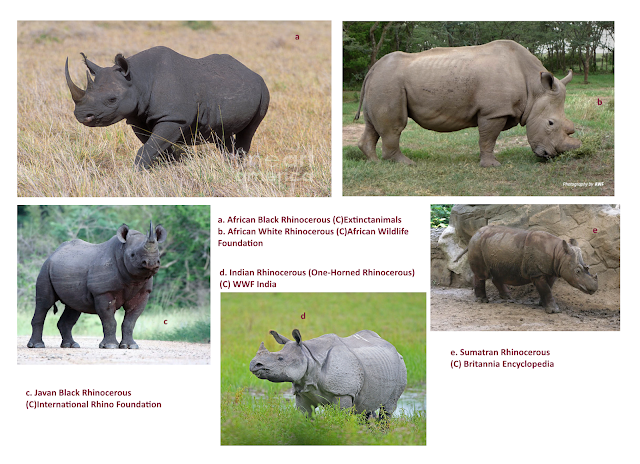
Rhinoceros have been one of the oldest species and are endangered in the grim of extinction. There are five extant species of rhino available in the wild, which are:

1. Asian Rhino: a. Javan Rhinoceros (Critically Endangered); b. Sumatran Rhinoceros (Critically Endangered); and c. One-horned or Indian Rhinoceros (Vulnerable)

2. African Rhino: a. White Rhinoceros (Near Threatened); and b. Black Rhinoceros (Critically Endangered)

The difference between the Asian and the African Rhino is the absence of teeth in the African Rhino which pluck the leaves (food) using lips. Other food will include fruits, grass, and farm crops. The ones that stand out are the Sumatran Rhinos, the smallest of all of them that are dark-red brown with short, stiff, and dark-coloured hair.

A general description of any species of the rhinoceros that interest us is their stumpy legs, barrel body with one or two dermal horns (not of bones). Rhinoceros do not attack humans unless instigated and their eyesight is of no use in a fight; however, they have a very good sense of smell and hearing. These semi-nocturnal animals sleep by standing or by sitting and love playing in muddy pools and sandy river beds.

What makes Rhino the talk of the town of smugglers, especially when banned are their medicinal values and dagger handles. Moreover, rhinos are facing threat to survival for want of habitat, the forests. Thus WWF does its part to conserve Rhino through different programmes like AREAS (Asian Rhino and Elephant Strategy), African Rhino Programme, and Wildlife Trade Campaign to create awareness and financial support required for the conservation of habitats and the animals.

African Rhinos live for about 35 to 40 years in the grasslands and savannahs with humans as the only predators. They are fast runners galloping at a speed of 30 miles per hour and are strictly herbivores. These thick-skinned and small-brained animals love to eat leafy food that could ferment even the usually excreted fibrous materials.

Sunday, 22 February 2015

CyberBullying - A New Leash of Life Thereafter


The increase in the use of technology in today's world has resulted in development of new applications and softwares that could be used for the wellbeing of human kind. However, there is another side in the misuse of technology by nerds. They in pursuit of knowledge and wealth, develop technological applications and softwares for teasing, for fun and for stealing other’s time, knowledge and wealth. All these activities could be grouped as cyberbullying. This has necessitated the need to create awareness against cyberbullying.

Cyberbullying impacts the life of an individual, their family, society and their work life. As an individual, this is very difficult to manage emotions to overcome the cyberbully leading to frustration and affecting the normal work life of the individual. Performance of individuals at work decreases with increasing impact of cyberbullying. Family members who may not be aware and understand cyberbullying will express varying emotions and are prone to fall prey to the temptations of cyberbullies leading to misconceptions and disengagement in family life. This in turn affects the individual leading to disconnected social life like social isolation.

Cyberbullying is a punishable offence across the globe. While this is not legally acceptable as is affecting the normal life of the individual harming them; cyberbully could also lead to criminal activities like personal identity theft of passwords and bank balance. Cyberbully is also against human ethics as is violating the privacy of the individual and disrespecting their emotions by not gaining consent from the concerned individual who are targeted. When a cyber-activity is harming the individual and one's well-being in the society, then cyberbullying turns socially unacceptable as well.

Thus awareness is necessitated to create awareness amongst public from falling prey to cyberbullying and to prevent them from becoming cyberbullies due to ignorance. Owing to the the pacing speed in technological developments the craving for need of power, lust and money, thus increases the chance of cybercrimes and cyberbullies. Cyberbullying thus has the potential to turn into the buzz word in cybercrimes.

PS: This was a short essay prepared for an online course of academic writing from University of Reading, UK


Friday, 20 February 2015

Bharathanatyam Accessories or Jewels–How do I ask?


The classical dance of Tamil Nadu is Bharathanatyam. This elegant dance of various postures which requires the dancers to balance against gravity comes with lot of vivid and bright colours and expensive glittering ornaments. Here is a list of ornaments that a Bharathanatyam dancer will wear:

1. Waist Belt: These are ornaments worn around the waist region and is called ottiyanam. The various varieties are Golden Lakshmi or Temple Lakshmi or Temple round belt.

2. Bangles; These are ornaments worn around the wrist and when they are not of fixed size and is of a constant length is called a bracelet. But for dancers they only wear bangles that are usually gold or gold-plated and studded with stones, gems and pearls.

3. Arm Band; These are ornaments worn on the arms and could be worn directly or is tied around the arms. They come in metal which is much more traditional and stiff than the pearl studded ones that are generally tied around the arms. They are also called vanki  or bajuband.

4. Neck Ornaments; Generally there are two types of neck ornaments – long chain and choker or necklaces. The long chain usually comes with a pendant and is a chain or is a kaasu mala or other such mala in which many small pendants like gold coins or other designs are threaded together on a gold or silver thread.

5. Ear Ornaments: There are two things worn by dancers in their ears. They are the chain that lifts and bears the weight of the ear droppings or stud. The ear droppings or stud is usually made of colourful stones, gems or pearls and is either flat (mattal) or round (jimikki).

6. Nose Rings and Nose Studs: Nose rings and nose studs are small ornaments worn in the nose together by the dancers. Generally dancers will prefer two nose rings than a nose stud (mukutthi). Nose rings could be worn in the side (valayam) or in the center (nath bullaku, which is more commonly worn).

7. Hair and Head Ornaments: The various ornaments of the hair will include the set braid adorned with ornaments. The end of the braid is tied with a decorative bun called kunjalam, which is heavier and keeps the hair and head straight and a wave while dancing. The braid is decored with braid billai, a circular to different shaped ornaments of varying size (big to small from the top to bottom).

Head ornaments will include those that decorate the forehead and the front of the head. the come as a single strand with a pendant or with many pendants (called step) or in three chains (one to the back of the head, two to both the sides) with a pendant in the front. This ornament is called netrichudi or head band (Indian). This ornament comes with a pair of head pins that could be worn in the gaps of the front head, nearly seven inches apart – one in circular head pin called the chandra, worn on the right and the other a semi circular head pin called the surya, worn on the left.

The final piece of head ornament is the bun ornament called rakodi. These are big round stone or gem studded grandly designed bun pins that cover the tangles and holds the bun tight.

8. Ankle Bell: These are ornaments adorned in the legs that makes noise because of the big brass bells stitched to clothe or velvet pad or a leather pad. They make noises in synchronisation to the music and rhythm of the dancer’s movements. They are called gunghroo or salangai.

Thus these are the various ornaments that are adorned by Bharathanatyam dancers and find below a display of antique piece of bharathanatyam ornamental set.

Tuesday, 10 February 2015

Kinds of Coffee: More than one flavour to relish your coffee!!! A Cuppa to your Valentine


COFFEE is the buzz word on a busy day!!! Oh! I got a headache! Oh! I need to get all these done by today! And, there you go with a cup of coffee from the cafeteria to keep you going till you end the day. Did you know? There are nearly 59 ways to prepare a CUPPA!!!

Ristretto: This is highly concentrated espresso having 0.75 ounce of espresso with very less water to pass through the coffee ground.

Espresso: This is strong black coffee prepared by using dark roasted coffee beans and hot steam in an espresso coffee machine, thus leaving a thick golden foam on the top. One may add sugar to taste and could have it as “short” (concentrated) or “long”.

Doppio: Double shot espresso for those who can take it.

Lungo: A 2 to 3 shots of espresso that passes through coffee grounds more number of times.

Cafe crema: Also called long black this coffee preparation is prepared by brewing for longer period using nearly 180 ml to 240 ml of water using manual pressure.

Espressino: A combination of Italian coffee drink prepared with equal parts of espressino and steamed milk.

Affogato: A scoop of vanilla gelato or ice cream with a shot of hot espresso.

Cafe con Hielo: A cup of hot coffee – white or black – with desired amount of sugar added is poured over a glass of ice.

Cafe Cubano: Cuban coffee is mixing few drops of espresso with sweet natural brown sugar and slowly adding the remaining espresso to a light brown foamy layer.

Espresso Romano: A single shot of espresso topped with a fresh peel of lemon.

Macchiato: This is of two types: Caffe Macchiato in which a shot of espresso is added with a small amount of foamed milk; and is also called espressino macchiato; and in Latte Macchiato in which half a shot of espresso is added to foamed milk.

Caramel Machiato: A combination of espresso, caramel and foamed milk or hot milk with vanilla essence to add flavour makes this as one of the addictive coffee drink to give you the perfect experience of the java beans.

Cafe con leche: A Spanish white coffee drink prepared by adding a shot of espresso to scalded milk.

Cortado: This Spanish coffee preparation of espresso with warm milk to reduce acidity in proportions of 1:1 to 1:2.

Cortadito: This is Cuban coffee version of Cortado that is served in a special glass with metal base and metal handle. Cortado condensada or bombon is a variation in which milk is replaced with condensed milk and leche y leche in which the condensed milk is topped with cream.

Piccolo Latte: This is ristretto shot served in a small latte glass topped with warm and silky milk sans cream.

Cappuccino: A combination in equal parts od espresso, steamed milk and milk froth complemented with unsweetened with cocoa powder and grated dark chocolate.

Flat White: A black coffee with milk.

Cafe au lait: This is French coffee prepared in brewed coffee and hot milk in equal parts. Thus is much weaker than caffe latte.

Breve: A milk-based espresso drink prepared with steamed milk and cream in half-and-half ratio.

Red Eye: Fortified coffee drink in which espresso is mixed with a shot of drip or filter coffee.

Black Eye: A cup of coffee that has black marking caused by pouring out a shot of espresso on a scoop of cream.

Americano: This is a single shot of espresso added to a cup of hot water with or without milk. However, this famous drink of Americans is best preferred with minimum quantity of milk added.

Vienna: A creamy cup of coffee prepared by mixing two shots of espresso with whipped cream until the standard cup is full and twirled with cream and sprinkled with chocolate chips.

Mocha: Also called Mocaccino is a chocolate flavoured caffe latte. This is prepared with a shot of espresso and hot milk with chocolate – dark or milk chocolate.

Borgia: Borgia is a delicious coffee made using equal proportions of hot chocolate and espresso and topped with whipped cream and grated orange peels.

Caffe Latte: A caffe latte is combination of single shot of espresso and three parts of hot milk.

Ca Phe Sua Da: A cup containing sweetened condensed milk is mixed with Vietnam grown roasted dark coffee beans which is brewed using a French metal drip filter over ice.

Galao: This is a Portugal hot coffee prepared by mixing espresso with foamed milk in 1:3 ratio.

Frappe: Cold espresso prepared with 1 – 2 teaspoons of instant coffee with sugar, water and ice, which is placed in ice in a long glass and milk to prepare coffee milkshake.

Mazagran: Cold sweetened coffee beverage of Portuguese combining espresso ,lemon and rum.

Irish Coffee: An alcoholic coffee drink that is prepared with a shot of Irish whiskey in a whiskey glass and three cubes of sugar filled with strong black coffee and topped with heavy cream.

Schiumatto: This is a coffee preparation with one shot of espresso topped with frothy milk.

Decaffeinato: The use of decaf coffee for preparation of a cuppa is decaffeinato.

Espresso Con Panno: Topping a cuppa espresso with whipped cream.

Espresso Corretto: Espresso with a splash of grappa, cognac or sambuca (liquor or brandy). This is an Italian preparation.

Espresso Macchiato: Espresso with a dollop of steamed milk decored artistically.

Caffe Americano: A shot of espresso diluted to the strength of drip coffee by adding hot water.

Cafe Mocha (Mochachino): This is cappucino or caffe latte complemented with chocolate syrup or powder and garnished with whipped cream.

Cafe Breva: Cappucino with half and half milk instead of whole milk to give a more richer and creamier flavour.

Cafe Macchiato: A shot of espresso with steamed milk in 4:1 ratio.

Cafe Latte Fredo: This is Cafe Latte prepared in cold milk and shook with ice in a cocktail shaker.

Espresso Granita: A cocktail coffee combining a shot of epsresso, splash of brandy and a teaspoon of brown sugar. This is frozen and crushed to prepare a drink in parfait glass with whipped cream.

Turkish Coffee or Greek Coffee: A thicker coffee prepared in a special long-handed, open brass or copper pot called ‘cezve’. finely ground fresh coffee beans is boiled in water to prepare muddy coffee that is thick and served on ‘Demitasse’ cups with sugar and cardamom pods (Turkish) or Arabic spices or chicory (Greek).

Indian (Madras) Filter Coffee: Freshly ground coffee beans is drip filtered using a traditional metal coffee filter and mixed with milk in 1:3 ratio.

Cafe Melange: A black coffee mixed or topped with whipped cream.

Carajillo: A Spanish coffee drink prepared by mixing coffee with brandy or rum or by heating the poured spirit and adding lemon, sugar and cinnamon.

Eiskaffee: German preparation of ice coffee prepared combining strong and chilled coffee, milk and ice cream (vanilla) with chocolate chip toppings.

Bicerin: This is a good combination of coffee (espresso), chocolate and whole milk in small rounded glasses.

Yuanyang: A Hong Kong coffee with tea which is prepared by mixing coffee with Hong Kong style milk tea as cold or hot.

Indian Herbal Coffee: A simple decoction of coffee prepared with few medicinal herbs of India like dry ginger, coriander seeds, pepper, cumin seeds and palm sugar or jaggery. Some people add more flavour using basil or omam leaves.

So isn’t the best time to take your Valentine for a cup of coffee!!!

Monday, 2 February 2015

DUNG BEETLE – I AM A WEIGHTLIFTER!


How am I known? I am also known as dung chafer or tumblebug. What I am known for is my dark black body with a metallic lustre that is copper or green in colour.

Why am I popular? I eat dung and am a farmer’s friend! Yes, I chew dung to “nothing” that is easy to digest for other organisms that share my habitat. I am also popular through the movie “MUMMY” where you see me as “scarab” that is a terror attacking in multitude showing that I am symbol of Egyptian Civilization.

Where do I live? Cold or dry weather like desert, prairies, farms, forests and grass lands. These are the habitats and they are omnipresent all over the world except for the continent of Antarctica. They feed on excreta of herbivores, in particular, and omnivores, and also on mushrooms, decaying leaves and fruits. There is a carnivore dung beetle, Deltochilum valgum, in South America that feeds on millipedes.

Dung beetles sense the presence of dung, capture the dung in small balls and take the dung ball to their burrow in a straight line and bury them inside the ground. They prefer carrying the dung ball in a straight path across all obstacles on the way and the possibility of getting stolen by other dung beetles. They maintain the path of travel in accordance with the moonlight.

Do you know the weight of dung carried by the dung beetle? They carry dung that weighs 50 times their own body weight. What’s more? A male Onthophagus taurus dung beetle carries dung that is 1,141 times more than its body weight ≡ a normal person pulling a double decker bus full of people.

Why do they carry these dung to their burrows? Stores food or Mating! If the beetle is going to store food you will find a single beetle struggling with the dung ball and if you find two beetles carrying across a dung ball, one being a male and other being a female, then is part of the mating process – “rolling process”. Later they use these dung balls to mate underground, work on preparing brooding ball and lays eggs to breed larvae. The larvae feeds on the nutrients from this brooding ball and thrives until independent.

There are two more varieties of dung beetle than the rollers: Tunnelers, jump into the dung and dig a ball right down into the ground and Dwellers, jump onto the top of a dung and make themselves comfy.

Monday, 26 January 2015

Display of Diverse Indian Culture – Indian Breads in Indian Cuisine


Indian Breads are those prepared from batter prepared using powdered grains with water in appropriate proportions. They could be steamed, baked, fried or grilled. There are different kinds of Indian bread preparations and each standing evident for the state and culture of the people suiting their agro-climatic zones. They could spicy, sweet or sour preparations made from fermented or unfermented batter.
Briefed below are a gist of various kinds of Indian breads prepared at Indian homes and food services that are broadly classified into flatbreads and crepes:

Appam (Kerala): This is a delicacy from South India prepared with rice batter in a special tava over steam using fermented rice batter and coconut milk. The most common side dish for this preparation are sweetened coconut milk and goat leg soup (paya) preparation. This is a typical desi pancake from India for breakfast or dinner. 

Idiyappam is an extension of the same batter that is prepared with rice flour dough moulded into strings, steamed and served with a range of side dishes from lentils to chicken gravy.

Nei appam (Tamil Nadu): These are also prepared using rice batter with jaggery that could either be steamed or fried. This is a food of Goddess served in many temples as “Prasadham”. They are usually cooked in ghee when served to Goddess and thus the name nei appam. This is more common food found in TamilNadu.

Kuzhi Paniyaram: This a delicacy in Tamil Nadu made during special occasions in the rural parts of the state by steaming a batter made from black lentils and rice. They are served either sweet or spicy with jaggery or sauted green chillies and onions.They are made on special pans and stir fried in gingely oil or ghee. There are many varieites that could be made with this dish like adding fruits and pepper and vegetables.

Idli: These are traditional breakfast of South India that are prepared for regular and daily consumption for breakfast or dinner from the fermented batter of black lentils and rice. The batter is steam cooked into cakes of two to three inches and served hot with colourful chutneys and lentil soup (sambar). Other vraiotions of this food are sambar idli (soaked and served in sambar), mini idlis (soaked in sambar, rasam or buttermilk), tatte idli (Karnataka), sannas (Goan variation), rava idli and muday idli (Mangalorean variety). They are also served with dry spice powder mixed with gingely oil.


Bakarkhani: Baqerkhani or bakar khan roti are thick and flat spicy bread made with a batter of flour, semolina, sugar, molasses soaked in saffron, poppy or nigella seeds, salt and ghee. They have a hard crust that could be eaten like a biscuit. The food is usually cooked in Kashmir and some parts of India near Bangladesh.

Bhatoora: This is a fluffy, deep-fried leavened bred made in North India and is usually served with channa or chole making the infamous, Chole bhature combination. The bhature is made of knead made from white flour, yoghurt, ghee or oil and baking powder or yeast and allowed to raise. The flattened dough is cooked in hot oil and deep fried to form the fluffy, light browned and chewy bread.

Kulcha: This is an alternate form of the dough baked on direct heat in earthen clay oven until they are golden brown without oil. This is a typical Punjabi recipe that is eaten by both Punjabis of India and Pakistan. They are served with butter and chole or channa cooked spicy hot. Amristar is famous for these kind of breads and they are served in the Golden Temple.

Chapati: These are unleavened flatbread prepared in many countries like India, Nepal, Bangladesh and Pakistan that are prepared with wheat flour dough knead with slat, oil and milk. They are cooked on both the sides of the pan. In South India people usually apply oil or ghee at the time of cooking while in North India oil or ghee or butter is applied at the time of serving. Chapati is served with a number of side dishes ranging from spicy and hot pickle to lentils or curd or raita to spicy vegetarian and non-vegetarian gravy preparations.

Roti: Roti is a typical resemblance of flatbread made like chapati but the difference lies in the flour, stone-ground whole meal flour and therefore the dough will be much coarser. They are cooked on flat or slightly concave iron tawa using unleavened dough. They are normally eaten with curries and vegetable gravy. These rotis are the ones that are used to make the modern wraps with tasty and healthy stuffing.

Tandoori Roti: Tandoori roti is a popular unleavened bread made from whole wheat flour on clay oven or tandoor and is possible to cook them over pressure pan. They are served with spicy and gravy dishes of meat and vegetables.


Dosa: These are fermented crepe prepared from batter of black lentils and rice. This is a delicacy of South India and is no les popular in other neighbouring countries like Sri Lanka, Nepal, Singapore and Malaysia. Dosa went under transformation with time – softer and thicker (kaldosai) to thinner and crispier dosa (paper dosa) of this new world. Dosa is served with side dishes similar to idly, sambar and chutney. There are nearly 200 variations in dosa and many parts of Tamil Nadu host Dosa Festival as a treat to winter.

Uttapam: These are also crepe preparation made from the same batter prepared for dosa but the thicker pancake is crispier on the outer surface and softer in the inner layers like idli. The crepe is usually coked on one side and is topped with a range of toppings like onions, pepper, green chillies, mixed vegetables and sometimes even meat.


Luchi: This is a flatbread native to Odisha, Bengal and Assam that are deep-fried flat bread made of white flour. They are very small in size and served usually with dum aloo or aloo matter. These breads though crispy are never brown in colour. When stuffed, luchi are called kochuri. 

Puri are made with whole wheat flour and turns brown on deep-fry.

Phulka: This is a soft flatbread preparation cooked over dry heat with dough made with a mixture of soya flour and wheat flour and served hot with vegetable curries. For the making of phulka on direct flame or heat they have a special griddle made on which the flattened dough could be placed. The bread is turned over using tongs.


Naan: This is a oven-baked leavened flat bread that is typically made in South Asia which is prepared from white flour with salt, yeast and yogurt. The preparation is soft though elastic and is cooked in a number of forms using butter or ghee and flavoured. They are served with dal (lentil soup), vegetable curries and non-vegetarian curries.

Thepla (Gujarati): These are spicy flattened semi - soft bread with the main proportion of flour being made from whole wheat flour mixed with spices and curd, and cooked over a tawa or griddle using little oil. They are served with chunda or sweet mango pickle.


Paratha: This is a typical Punjabi bread and is the most popular unleavened flat bread eaten in Punjab. The bread is also called parantha and could be prepared in differing shapes. They are prepared using whole wheat flour kneaded with hot oil, raised and cooked over tava or direct heat to puff into layers without oil or ghee. The oil or ghee is usually applied to hot paratha that is served immediately with dal, raita, vegetable curries or non-vegetarian gravies. Parathas could be cooked with fillings or stuffing and cooked to make a number of varieties.

Parotta: Better known as Barotta is a flattened multi - layered unleavened bread made of white flour with egg oil or ghee and water. The bread is beaten to a number of times and usually served with vegetable kuruma or chicken or beef or mutton stew. Parotta comes in a number of variations and diced variations are chilli and kothu parotta.


Puran Poli: Known in different names is popularly known in Tamil as boli and is a sweet flatbread of India that is prepared in the states of Tamil Nadu, Maharashtra, Andhra Pradesh, Karnataka, Gujarat and Goa. The stuffing for the poli is made of grated coconut mixed with jaggery and roasted condiments like nutmeg or cardamom. This is usually golden yellow in colour and is cooked with ghee on a hot griddle. The range of stuffing could also include lentils and nuts.

Pathiri (Kerala): This is a pancake made mostly by Muslims in Kerala using rice flour dough and baked on oadu pans. They are later served with coconut milk that increases the flavour and retains the softness of the dish. Pathiri varieties will include ghee battered, fried pathiri and fish or meat stuffed pathiri. They are regular delicacy of the month of Ramdan.


Dondiyala-Khakhra: These are left over rotis that are turned into crispy khakhras by grilling on dying charcoal fire using tongs and served with hot pickles and vegetables. They carry a smoky and sweet flavour of burnt roti. These khakhras are served hot with pickles and vegetables.

Is there any better evidence that anyone can tie up the diverse culture of India with food?


Tuesday, 30 December 2014

HOW GASES MOVE IN PLANTS? – RICE AS MODEL SPECIES


Rice is a semi-aquatic model crop grown widely in regions of seasonal rainfall. Therefore, submergence is one of the most common abiotic stresses that result in reduced oxygen supply for respiration at night. This in turn reduces the rate of respiration at night resulting in decreased survival of rice plants.

So rice plants adapted to use the oxygen released during underwater photosynthesis, which forms a gas film layer around these submerged leaves. This physiological adaptation is supported by the super-hydrophobic leaves that have a thicker cuticle with increased permeability. These two traits enhance oxygen exchange to submerged shoot regions at night.

In this specific study, the influence of gas film layer on the rate of oxygen transport and resistance to oxygen transport was measured against variabilities in stomatal characteristics, cuticle permeability and thickness of diffusive boundary layer (standing water or bulk water). The use of 3D simulation modelling for this study is a very novel experimental approach and highlights a turning point in plant physiological studies.

The scientists concluded from the hypothetical results that there is a 22 fold reduction in the resistance against oxygen transport rate due to the presence of gas film layers in submerged rice leaves with high cuticle permeability and fully open stomata. This model also predicted the direction of oxygen transport through open stomata to be perpendicular and through closed stomata to be oblique.

Hence these adaptations confirm that rice crop have better survival strategy in regions with seasonal inundation problem and thus can serve as the crop of choice for rotation during wet season.


Reference: VERBOVEN, P., PEDERSEN, O., HO, Q. T., NICOLAI, B. M. and COLMER, T. D. (2014), The mechanism of improved aeration due to gas films on leaves of submerged rice. Plant, Cell & Environment, 37: 2433–2452. doi: 10.1111/pce.12300