Saturday, 7 November 2015

Shop Green, Consume Less and Save More!!!

I wrote of five-day Green Concepts for celebrating Diwali....good on you here I am all set up in a much better environment to write on having a Greener Diwali!!!

(C) conceptartworld


Needless to say, with the very word of Diwali I find the spirits go high in my Hindu friends...there seems to be an adrenaline rush with time nearing Diwali which one can see in the colors, hustle-bustle of the crowd in shopping malls, savories being spicy and sweet tingling tongue to passerby on seeing the busy road-side shops and winter flowers of all kinds drenching the sweaty smell of the crowd.

Here, I am blessed this year to write a few tips on Green Shopping following the Green Concepts that I wrote last year:

For more, click this Green Shopping link from EPA.

A few things to mind while you do your seasonal shopping to make it "Go Green":

1. Carry your bags - jute shopping bags that you can avoid as many plastic bags as you can in all the shops you shop, save on your time, money, luggage, and travel.

2. Plan your shopping to the maximum you can - the least anyone can do is to decide to shop which one first to begin and finish your day out with where you dine last, your shopping route - not only saves your day and time but traffic for others.

3. Try to buy stuff that you will need only and are more "green" - like made from natural products, biodegradable, and energy-efficient.

Happy Go Green Shopping!!!

Wednesday, 16 September 2015

Wood Apple This Vinayagar Chathurthi !!!!!

Well, this seasons time for elephants in the wild and in fences to have their "slurps" and "burps!" after eating the yummy nutritious wood apples.... Piles of wood apples Will be out in the market today for tomorrow and maybe a few more days.

Wood apple are the favourite food of elephants and thus finds a sacred place as offering to Lord Ganesha or Vinayagar. Falling in line with this, I remind you once again of the logo competition conducted globally for a local cause: please check on the post:

"My W(orld) E(nvironment) D(ay)ding Plan for 2015!!! LOGO COMPETITION!!!"

Wood apple is also known as Bel Fruits, Elephant Apples, Monkey Fruits and is botanically known as:  Limonia acidissima. The characteristics of this fruit are:

* Tough brown shells that resembles wood,
* Tasty, pulpy brown pulp with white seeds.

How to eat?

1. Scoop out and eat raw like any other fruit;

2. Scoop out, freeze and eat like ice cream;

3. Wood apple jams;

4. Wood apple milkshakes;

5. Wood apple chutney, and

6. Wood apple leaves are used to make chutney.

Nutritional Value:

They are rich source of vitamins (in specific Vitamin C), tannins, calcium, phosphorous, finer, protein and iron.

As I plan to relish a few wood apple this year, I request you to join my quest to raise funds for these wood apple lovers - temple elephants!

Tuesday, 23 June 2015

A Turkish Delight For Ramadan!!! BAKLAVA!!!


Here is a Turkey Delight that will water your mouth this Ramadan!!! Wonder where I can taste one and share one with memories that are everlasting!!! Well, the sweet is sweet!!! And, that is BAKLAVA!!!

A sweet delight from the Turkey Muslims prepared specially during the Ramadan season using phyllo pastry sheets, filled with sweetened chopped nuts in sugar syrup and baked to ready to eat!!! And to add flavour are lemon juice or spices and honey with or without rosewater…..Baklava is then baked and cut into different shapes to be served as a dessert.

Melts in the mouth when served hot and is all different when served cold with a scoop of ice cream!!! But for Ramadan, is a hot sweet that is more preferred!!!

Well as I read through various resources, I understand the spread of this sweet savoury to Middle East, Arab, Greek and Albania.

There are different varieties of Baklava:
  • Cinnamon and Nuts Baklava
  • Quick Crescent Baklava
  • Easy Baklava
  • Chocolate Baklava
  • Santorini Sublime Baklava
  • Sezak’s Baklava
  • Pistachio Baklava
  • Fig and Cardamom Baklava in Lemon Syrup

A Very simple way to cook Baklava!!!

Prepare the phyllo sheets by spreading them into the baking tray and spreading enough butter. Layer the fillings and top with some more phyllo sheets and alternate with layers or prepare a single layered Baklava!!! Cut them, bake and when hot top with sugar syrup and with desired flavour before serving…after 12 hours…

To add some more info for how Baklava becomes a tradition of Ramadan in Turkey that my colleague shared: A dish that they used to share with poorer Muslims than them in their country when they break the fast by the end of the day with other food prepared to end the fast by dusk….Furthermore she added that she is not thinking that I am poorer than her but is wanting to share her culture of Ramadan to me….

HAPPY RAMADAN SEASON!!!!

Thursday, 4 June 2015

My W(orld) E(nvironment) D(ay)ding Plan for 2015!!! LOGO COMPETITION!!!


This year World Environment Day (WED) on June 5th, 2015 is going to be a memorable one if you will all co-operate!

I decided that I can move a step ahead by introducing a logo for my community and thought my valuable members and others who are interested can give a helping hand!!!


My WEDding Plan 2015!!!


PARTICIPATE IN LOGO COMPETITION!!!
Anyone interested can join this logo competition!!! Age is not a bar!!!
Create a logo and send a PDF and .JPEG file to
ecoagriat@gmail.com and WIN PRIZES!!!
THEME: COUNT WHAT YOU SAVE FOR TOMORROW!
ENTRY REQUIREMENTS:
1. Participants need to register their entry with a small fee of Rs. 25/- per entry submitted.
2. Logo file should not be more than  100 KB.
3. Entries should be submitted as PDF and .JPEG files to my email id: ecoagriat@gmail.com
4. Only registered entries will be considered for the prizes.
5. All entries submitted are sole property of this community and cannot be reproduced or submitted elsewhere.
6. Last Date for submitting entry is before 31st December, 2015 before 10:00 PM.
7. Winners will be announced within 7 working days.
PRIZES !!! PRIZES!!!

WIN A T-SHIRT WITH YOUR LOGO IMPRINTED!!!

Monday, 1 June 2015

BEAT THE HEAT THIS SUMMER AND EVERY SUMMER :-) - An UPDATE


I REPEAT!!!

HEAT WAVE strikes this year again!!! Heat wave is a prolonged period of extreme heat and humidity that can slow down the metabolism of the body to maintain normal body temperature. Increase in temperature will result in overheating of the body that results in heat-related illnesses. Some of the heat-related illnesses are heat stroke, heat exhaustion, heat cramps, heat syncope (fainting) and heat rash. Of all these, heat stroke is the worst that could collapse people instantly.
Symptoms and Signs of heat related illnesses: Increased body  temperature but not fever, headache, nausea, vomiting, diarrhoea, weakness, lethargy, headache, confusion, fainting, dizziness, muscle cramps, seizures and coma.
Heat Rash: Itchy and prickly skin, a common heat allergic symptom that appears with red bumps on the skin.
Heat Syncope or Fainting: Dizziness and fainting as a result of dehydration, heat and hypotension.
Heat Cramps: Involuntary spasms of the muscles, in general legs with significant sweating.
Heat Exhaustion: Tiredness and profuse sweating due to heat exemplifies as headache, nausea, vomiting and muscle cramps.
Heat Stroke: This is a medical emergency that can collapse individuals and will require immediate attention. Main signs of heat stroke are dizziness, muscle cramps and aches, nausea and vomiting, fatigue, headache or head weight, confusion that finally results in coma when the individual collapses.
Never mind, there are many things that one can do to beat the heat!!! BEAT IT – PREVENT OR TREAT IT!
Heat-related illnesses are more common in children up to four years, aged people above 65 years, overweight people, overexertion due to work and/or exercise, mental illness and in chronically ill patients and under certain medications.
Treatment:
a. Heat Stroke: Immediately shift the patient to cool indoors or shady outdoors to the nearest point and remove restrictive clothing. Blow cool air and shower them with cool water. Wrap in cool sheet and place ice packs in armpits, neck and groin. Keep checking the body temperature until near normal. If the individual is awake provide them with plenty to drink and try mouth feeding. Call doc for medical emergency.
b. Heat Exhaustion: Drink plenty of water, eat few salty snacks, rest in shade, have a cool shower and loosen restrictive clothing.
c. Heat Cramps: Rest in a shady place and drink plenty of fluids like water, fruit juices and isotonic solutions, Good to have something salted. Stretch the muscles and seek medical attention if cramps prolongs.
d. Heat Syncope: Rest in a cool and shady place, stretch and relax and drink plenty of fluids. Will need to seek medical attention if required on repeated fainting episodes.
e. Heat Rash: Wearing loose and cotton clothing, keeping cool to reduce sweating and using powder to dust to prevent sweating and dirt accumulation help to prevent heat rash formation.
 

Golden Rules During Heat Waves:

1. Try to stay indoors and avoid peak sunlight hours from 10 AM. to 3 PM.

2. Drink plenty of fluids in various forms but cool and reduce caffeine and alcohol; reduce solid food as well.

3. Replenish the minerals in your body using isotonic juices or increasing high-salt food intake.

4. Prefer cotton, white or pale coloured and loose clothing. Use a hat and apply plenty of sunscreen with SPF – 15 or 30 as per the requirement for UV protection (a good one is with moisturiser in specific for tropical climate).

5. Do your chores, jobs and work outside at a slower pace than normal to reduce exertion and energy loss. 

6. EAT SEASONAL FRUITS - The watery ones like melons and citrus to keep you rehydrated!!! DRINK juices, tender coconut, ice-creams than caffeinated and soft drinks!!! 

7. CARRY a bottle of water, if not at least a BOTTLE that could be filled in and on the way!!! - QUENCH your thirst and even better AVOID THIRST!!!

I wish that the next summer will much more enjoyable!!!


Friday, 20 March 2015

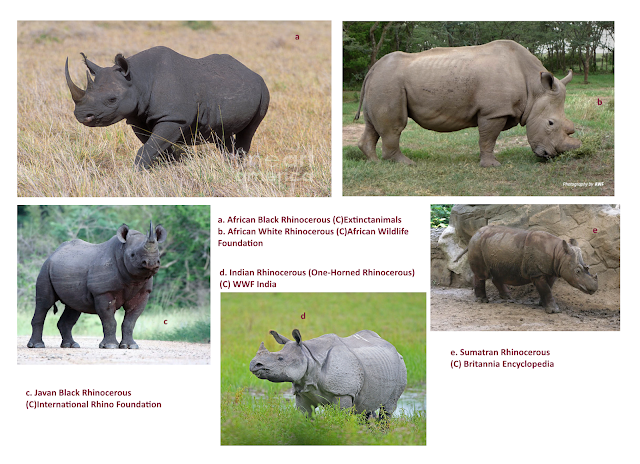
RHINOCEROUS – THE AGGRESSIVE DEFENDER IN THE WILD


Rhinoceros have been one of the oldest species and are endangered in the grim of extinction. There are five extant species of rhino available in the wild, which are:

1. Asian Rhino: a. Javan Rhinoceros (Critically Endangered); b. Sumatran Rhinoceros (Critically Endangered); and c. One-horned or Indian Rhinoceros (Vulnerable)

2. African Rhino: a. White Rhinoceros (Near Threatened); and b. Black Rhinoceros (Critically Endangered)

The difference between the Asian and the African Rhino is the absence of teeth in the African Rhino which pluck the leaves (food) using lips. Other food will include fruits, grass, and farm crops. The ones that stand out are the Sumatran Rhinos, the smallest of all of them that are dark-red brown with short, stiff, and dark-coloured hair.

A general description of any species of the rhinoceros that interest us is their stumpy legs, barrel body with one or two dermal horns (not of bones). Rhinoceros do not attack humans unless instigated and their eyesight is of no use in a fight; however, they have a very good sense of smell and hearing. These semi-nocturnal animals sleep by standing or by sitting and love playing in muddy pools and sandy river beds.

What makes Rhino the talk of the town of smugglers, especially when banned are their medicinal values and dagger handles. Moreover, rhinos are facing threat to survival for want of habitat, the forests. Thus WWF does its part to conserve Rhino through different programmes like AREAS (Asian Rhino and Elephant Strategy), African Rhino Programme, and Wildlife Trade Campaign to create awareness and financial support required for the conservation of habitats and the animals.

African Rhinos live for about 35 to 40 years in the grasslands and savannahs with humans as the only predators. They are fast runners galloping at a speed of 30 miles per hour and are strictly herbivores. These thick-skinned and small-brained animals love to eat leafy food that could ferment even the usually excreted fibrous materials.

Sunday, 22 February 2015

CyberBullying - A New Leash of Life Thereafter


The increase in the use of technology in today's world has resulted in development of new applications and softwares that could be used for the wellbeing of human kind. However, there is another side in the misuse of technology by nerds. They in pursuit of knowledge and wealth, develop technological applications and softwares for teasing, for fun and for stealing other’s time, knowledge and wealth. All these activities could be grouped as cyberbullying. This has necessitated the need to create awareness against cyberbullying.

Cyberbullying impacts the life of an individual, their family, society and their work life. As an individual, this is very difficult to manage emotions to overcome the cyberbully leading to frustration and affecting the normal work life of the individual. Performance of individuals at work decreases with increasing impact of cyberbullying. Family members who may not be aware and understand cyberbullying will express varying emotions and are prone to fall prey to the temptations of cyberbullies leading to misconceptions and disengagement in family life. This in turn affects the individual leading to disconnected social life like social isolation.

Cyberbullying is a punishable offence across the globe. While this is not legally acceptable as is affecting the normal life of the individual harming them; cyberbully could also lead to criminal activities like personal identity theft of passwords and bank balance. Cyberbully is also against human ethics as is violating the privacy of the individual and disrespecting their emotions by not gaining consent from the concerned individual who are targeted. When a cyber-activity is harming the individual and one's well-being in the society, then cyberbullying turns socially unacceptable as well.

Thus awareness is necessitated to create awareness amongst public from falling prey to cyberbullying and to prevent them from becoming cyberbullies due to ignorance. Owing to the the pacing speed in technological developments the craving for need of power, lust and money, thus increases the chance of cybercrimes and cyberbullies. Cyberbullying thus has the potential to turn into the buzz word in cybercrimes.

PS: This was a short essay prepared for an online course of academic writing from University of Reading, UK


Friday, 20 February 2015

Bharathanatyam Accessories or Jewels–How do I ask?


The classical dance of Tamil Nadu is Bharathanatyam. This elegant dance of various postures which requires the dancers to balance against gravity comes with lot of vivid and bright colours and expensive glittering ornaments. Here is a list of ornaments that a Bharathanatyam dancer will wear:

1. Waist Belt: These are ornaments worn around the waist region and is called ottiyanam. The various varieties are Golden Lakshmi or Temple Lakshmi or Temple round belt.

2. Bangles; These are ornaments worn around the wrist and when they are not of fixed size and is of a constant length is called a bracelet. But for dancers they only wear bangles that are usually gold or gold-plated and studded with stones, gems and pearls.

3. Arm Band; These are ornaments worn on the arms and could be worn directly or is tied around the arms. They come in metal which is much more traditional and stiff than the pearl studded ones that are generally tied around the arms. They are also called vanki  or bajuband.

4. Neck Ornaments; Generally there are two types of neck ornaments – long chain and choker or necklaces. The long chain usually comes with a pendant and is a chain or is a kaasu mala or other such mala in which many small pendants like gold coins or other designs are threaded together on a gold or silver thread.

5. Ear Ornaments: There are two things worn by dancers in their ears. They are the chain that lifts and bears the weight of the ear droppings or stud. The ear droppings or stud is usually made of colourful stones, gems or pearls and is either flat (mattal) or round (jimikki).

6. Nose Rings and Nose Studs: Nose rings and nose studs are small ornaments worn in the nose together by the dancers. Generally dancers will prefer two nose rings than a nose stud (mukutthi). Nose rings could be worn in the side (valayam) or in the center (nath bullaku, which is more commonly worn).

7. Hair and Head Ornaments: The various ornaments of the hair will include the set braid adorned with ornaments. The end of the braid is tied with a decorative bun called kunjalam, which is heavier and keeps the hair and head straight and a wave while dancing. The braid is decored with braid billai, a circular to different shaped ornaments of varying size (big to small from the top to bottom).

Head ornaments will include those that decorate the forehead and the front of the head. the come as a single strand with a pendant or with many pendants (called step) or in three chains (one to the back of the head, two to both the sides) with a pendant in the front. This ornament is called netrichudi or head band (Indian). This ornament comes with a pair of head pins that could be worn in the gaps of the front head, nearly seven inches apart – one in circular head pin called the chandra, worn on the right and the other a semi circular head pin called the surya, worn on the left.

The final piece of head ornament is the bun ornament called rakodi. These are big round stone or gem studded grandly designed bun pins that cover the tangles and holds the bun tight.

8. Ankle Bell: These are ornaments adorned in the legs that makes noise because of the big brass bells stitched to clothe or velvet pad or a leather pad. They make noises in synchronisation to the music and rhythm of the dancer’s movements. They are called gunghroo or salangai.

Thus these are the various ornaments that are adorned by Bharathanatyam dancers and find below a display of antique piece of bharathanatyam ornamental set.

Tuesday, 10 February 2015

Kinds of Coffee: More than one flavour to relish your coffee!!! A Cuppa to your Valentine


COFFEE is the buzz word on a busy day!!! Oh! I got a headache! Oh! I need to get all these done by today! And, there you go with a cup of coffee from the cafeteria to keep you going till you end the day. Did you know? There are nearly 59 ways to prepare a CUPPA!!!

Ristretto: This is highly concentrated espresso having 0.75 ounce of espresso with very less water to pass through the coffee ground.

Espresso: This is strong black coffee prepared by using dark roasted coffee beans and hot steam in an espresso coffee machine, thus leaving a thick golden foam on the top. One may add sugar to taste and could have it as “short” (concentrated) or “long”.

Doppio: Double shot espresso for those who can take it.

Lungo: A 2 to 3 shots of espresso that passes through coffee grounds more number of times.

Cafe crema: Also called long black this coffee preparation is prepared by brewing for longer period using nearly 180 ml to 240 ml of water using manual pressure.

Espressino: A combination of Italian coffee drink prepared with equal parts of espressino and steamed milk.

Affogato: A scoop of vanilla gelato or ice cream with a shot of hot espresso.

Cafe con Hielo: A cup of hot coffee – white or black – with desired amount of sugar added is poured over a glass of ice.

Cafe Cubano: Cuban coffee is mixing few drops of espresso with sweet natural brown sugar and slowly adding the remaining espresso to a light brown foamy layer.

Espresso Romano: A single shot of espresso topped with a fresh peel of lemon.

Macchiato: This is of two types: Caffe Macchiato in which a shot of espresso is added with a small amount of foamed milk; and is also called espressino macchiato; and in Latte Macchiato in which half a shot of espresso is added to foamed milk.

Caramel Machiato: A combination of espresso, caramel and foamed milk or hot milk with vanilla essence to add flavour makes this as one of the addictive coffee drink to give you the perfect experience of the java beans.

Cafe con leche: A Spanish white coffee drink prepared by adding a shot of espresso to scalded milk.

Cortado: This Spanish coffee preparation of espresso with warm milk to reduce acidity in proportions of 1:1 to 1:2.

Cortadito: This is Cuban coffee version of Cortado that is served in a special glass with metal base and metal handle. Cortado condensada or bombon is a variation in which milk is replaced with condensed milk and leche y leche in which the condensed milk is topped with cream.

Piccolo Latte: This is ristretto shot served in a small latte glass topped with warm and silky milk sans cream.

Cappuccino: A combination in equal parts od espresso, steamed milk and milk froth complemented with unsweetened with cocoa powder and grated dark chocolate.

Flat White: A black coffee with milk.

Cafe au lait: This is French coffee prepared in brewed coffee and hot milk in equal parts. Thus is much weaker than caffe latte.

Breve: A milk-based espresso drink prepared with steamed milk and cream in half-and-half ratio.

Red Eye: Fortified coffee drink in which espresso is mixed with a shot of drip or filter coffee.

Black Eye: A cup of coffee that has black marking caused by pouring out a shot of espresso on a scoop of cream.

Americano: This is a single shot of espresso added to a cup of hot water with or without milk. However, this famous drink of Americans is best preferred with minimum quantity of milk added.

Vienna: A creamy cup of coffee prepared by mixing two shots of espresso with whipped cream until the standard cup is full and twirled with cream and sprinkled with chocolate chips.

Mocha: Also called Mocaccino is a chocolate flavoured caffe latte. This is prepared with a shot of espresso and hot milk with chocolate – dark or milk chocolate.

Borgia: Borgia is a delicious coffee made using equal proportions of hot chocolate and espresso and topped with whipped cream and grated orange peels.

Caffe Latte: A caffe latte is combination of single shot of espresso and three parts of hot milk.

Ca Phe Sua Da: A cup containing sweetened condensed milk is mixed with Vietnam grown roasted dark coffee beans which is brewed using a French metal drip filter over ice.

Galao: This is a Portugal hot coffee prepared by mixing espresso with foamed milk in 1:3 ratio.

Frappe: Cold espresso prepared with 1 – 2 teaspoons of instant coffee with sugar, water and ice, which is placed in ice in a long glass and milk to prepare coffee milkshake.

Mazagran: Cold sweetened coffee beverage of Portuguese combining espresso ,lemon and rum.

Irish Coffee: An alcoholic coffee drink that is prepared with a shot of Irish whiskey in a whiskey glass and three cubes of sugar filled with strong black coffee and topped with heavy cream.

Schiumatto: This is a coffee preparation with one shot of espresso topped with frothy milk.

Decaffeinato: The use of decaf coffee for preparation of a cuppa is decaffeinato.

Espresso Con Panno: Topping a cuppa espresso with whipped cream.

Espresso Corretto: Espresso with a splash of grappa, cognac or sambuca (liquor or brandy). This is an Italian preparation.

Espresso Macchiato: Espresso with a dollop of steamed milk decored artistically.

Caffe Americano: A shot of espresso diluted to the strength of drip coffee by adding hot water.

Cafe Mocha (Mochachino): This is cappucino or caffe latte complemented with chocolate syrup or powder and garnished with whipped cream.

Cafe Breva: Cappucino with half and half milk instead of whole milk to give a more richer and creamier flavour.

Cafe Macchiato: A shot of espresso with steamed milk in 4:1 ratio.

Cafe Latte Fredo: This is Cafe Latte prepared in cold milk and shook with ice in a cocktail shaker.

Espresso Granita: A cocktail coffee combining a shot of epsresso, splash of brandy and a teaspoon of brown sugar. This is frozen and crushed to prepare a drink in parfait glass with whipped cream.

Turkish Coffee or Greek Coffee: A thicker coffee prepared in a special long-handed, open brass or copper pot called ‘cezve’. finely ground fresh coffee beans is boiled in water to prepare muddy coffee that is thick and served on ‘Demitasse’ cups with sugar and cardamom pods (Turkish) or Arabic spices or chicory (Greek).

Indian (Madras) Filter Coffee: Freshly ground coffee beans is drip filtered using a traditional metal coffee filter and mixed with milk in 1:3 ratio.

Cafe Melange: A black coffee mixed or topped with whipped cream.

Carajillo: A Spanish coffee drink prepared by mixing coffee with brandy or rum or by heating the poured spirit and adding lemon, sugar and cinnamon.

Eiskaffee: German preparation of ice coffee prepared combining strong and chilled coffee, milk and ice cream (vanilla) with chocolate chip toppings.

Bicerin: This is a good combination of coffee (espresso), chocolate and whole milk in small rounded glasses.

Yuanyang: A Hong Kong coffee with tea which is prepared by mixing coffee with Hong Kong style milk tea as cold or hot.

Indian Herbal Coffee: A simple decoction of coffee prepared with few medicinal herbs of India like dry ginger, coriander seeds, pepper, cumin seeds and palm sugar or jaggery. Some people add more flavour using basil or omam leaves.

So isn’t the best time to take your Valentine for a cup of coffee!!!

Monday, 2 February 2015

DUNG BEETLE – I AM A WEIGHTLIFTER!


How am I known? I am also known as dung chafer or tumblebug. What I am known for is my dark black body with a metallic lustre that is copper or green in colour.

Why am I popular? I eat dung and am a farmer’s friend! Yes, I chew dung to “nothing” that is easy to digest for other organisms that share my habitat. I am also popular through the movie “MUMMY” where you see me as “scarab” that is a terror attacking in multitude showing that I am symbol of Egyptian Civilization.

Where do I live? Cold or dry weather like desert, prairies, farms, forests and grass lands. These are the habitats and they are omnipresent all over the world except for the continent of Antarctica. They feed on excreta of herbivores, in particular, and omnivores, and also on mushrooms, decaying leaves and fruits. There is a carnivore dung beetle, Deltochilum valgum, in South America that feeds on millipedes.

Dung beetles sense the presence of dung, capture the dung in small balls and take the dung ball to their burrow in a straight line and bury them inside the ground. They prefer carrying the dung ball in a straight path across all obstacles on the way and the possibility of getting stolen by other dung beetles. They maintain the path of travel in accordance with the moonlight.

Do you know the weight of dung carried by the dung beetle? They carry dung that weighs 50 times their own body weight. What’s more? A male Onthophagus taurus dung beetle carries dung that is 1,141 times more than its body weight ≡ a normal person pulling a double decker bus full of people.

Why do they carry these dung to their burrows? Stores food or Mating! If the beetle is going to store food you will find a single beetle struggling with the dung ball and if you find two beetles carrying across a dung ball, one being a male and other being a female, then is part of the mating process – “rolling process”. Later they use these dung balls to mate underground, work on preparing brooding ball and lays eggs to breed larvae. The larvae feeds on the nutrients from this brooding ball and thrives until independent.

There are two more varieties of dung beetle than the rollers: Tunnelers, jump into the dung and dig a ball right down into the ground and Dwellers, jump onto the top of a dung and make themselves comfy.

Monday, 26 January 2015

Display of Diverse Indian Culture – Indian Breads in Indian Cuisine


Indian Breads are those prepared from batter prepared using powdered grains with water in appropriate proportions. They could be steamed, baked, fried or grilled. There are different kinds of Indian bread preparations and each standing evident for the state and culture of the people suiting their agro-climatic zones. They could spicy, sweet or sour preparations made from fermented or unfermented batter.
Briefed below are a gist of various kinds of Indian breads prepared at Indian homes and food services that are broadly classified into flatbreads and crepes:

Appam (Kerala): This is a delicacy from South India prepared with rice batter in a special tava over steam using fermented rice batter and coconut milk. The most common side dish for this preparation are sweetened coconut milk and goat leg soup (paya) preparation. This is a typical desi pancake from India for breakfast or dinner. 

Idiyappam is an extension of the same batter that is prepared with rice flour dough moulded into strings, steamed and served with a range of side dishes from lentils to chicken gravy.

Nei appam (Tamil Nadu): These are also prepared using rice batter with jaggery that could either be steamed or fried. This is a food of Goddess served in many temples as “Prasadham”. They are usually cooked in ghee when served to Goddess and thus the name nei appam. This is more common food found in TamilNadu.

Kuzhi Paniyaram: This a delicacy in Tamil Nadu made during special occasions in the rural parts of the state by steaming a batter made from black lentils and rice. They are served either sweet or spicy with jaggery or sauted green chillies and onions.They are made on special pans and stir fried in gingely oil or ghee. There are many varieites that could be made with this dish like adding fruits and pepper and vegetables.

Idli: These are traditional breakfast of South India that are prepared for regular and daily consumption for breakfast or dinner from the fermented batter of black lentils and rice. The batter is steam cooked into cakes of two to three inches and served hot with colourful chutneys and lentil soup (sambar). Other vraiotions of this food are sambar idli (soaked and served in sambar), mini idlis (soaked in sambar, rasam or buttermilk), tatte idli (Karnataka), sannas (Goan variation), rava idli and muday idli (Mangalorean variety). They are also served with dry spice powder mixed with gingely oil.


Bakarkhani: Baqerkhani or bakar khan roti are thick and flat spicy bread made with a batter of flour, semolina, sugar, molasses soaked in saffron, poppy or nigella seeds, salt and ghee. They have a hard crust that could be eaten like a biscuit. The food is usually cooked in Kashmir and some parts of India near Bangladesh.

Bhatoora: This is a fluffy, deep-fried leavened bred made in North India and is usually served with channa or chole making the infamous, Chole bhature combination. The bhature is made of knead made from white flour, yoghurt, ghee or oil and baking powder or yeast and allowed to raise. The flattened dough is cooked in hot oil and deep fried to form the fluffy, light browned and chewy bread.

Kulcha: This is an alternate form of the dough baked on direct heat in earthen clay oven until they are golden brown without oil. This is a typical Punjabi recipe that is eaten by both Punjabis of India and Pakistan. They are served with butter and chole or channa cooked spicy hot. Amristar is famous for these kind of breads and they are served in the Golden Temple.

Chapati: These are unleavened flatbread prepared in many countries like India, Nepal, Bangladesh and Pakistan that are prepared with wheat flour dough knead with slat, oil and milk. They are cooked on both the sides of the pan. In South India people usually apply oil or ghee at the time of cooking while in North India oil or ghee or butter is applied at the time of serving. Chapati is served with a number of side dishes ranging from spicy and hot pickle to lentils or curd or raita to spicy vegetarian and non-vegetarian gravy preparations.

Roti: Roti is a typical resemblance of flatbread made like chapati but the difference lies in the flour, stone-ground whole meal flour and therefore the dough will be much coarser. They are cooked on flat or slightly concave iron tawa using unleavened dough. They are normally eaten with curries and vegetable gravy. These rotis are the ones that are used to make the modern wraps with tasty and healthy stuffing.

Tandoori Roti: Tandoori roti is a popular unleavened bread made from whole wheat flour on clay oven or tandoor and is possible to cook them over pressure pan. They are served with spicy and gravy dishes of meat and vegetables.


Dosa: These are fermented crepe prepared from batter of black lentils and rice. This is a delicacy of South India and is no les popular in other neighbouring countries like Sri Lanka, Nepal, Singapore and Malaysia. Dosa went under transformation with time – softer and thicker (kaldosai) to thinner and crispier dosa (paper dosa) of this new world. Dosa is served with side dishes similar to idly, sambar and chutney. There are nearly 200 variations in dosa and many parts of Tamil Nadu host Dosa Festival as a treat to winter.

Uttapam: These are also crepe preparation made from the same batter prepared for dosa but the thicker pancake is crispier on the outer surface and softer in the inner layers like idli. The crepe is usually coked on one side and is topped with a range of toppings like onions, pepper, green chillies, mixed vegetables and sometimes even meat.


Luchi: This is a flatbread native to Odisha, Bengal and Assam that are deep-fried flat bread made of white flour. They are very small in size and served usually with dum aloo or aloo matter. These breads though crispy are never brown in colour. When stuffed, luchi are called kochuri. 

Puri are made with whole wheat flour and turns brown on deep-fry.

Phulka: This is a soft flatbread preparation cooked over dry heat with dough made with a mixture of soya flour and wheat flour and served hot with vegetable curries. For the making of phulka on direct flame or heat they have a special griddle made on which the flattened dough could be placed. The bread is turned over using tongs.


Naan: This is a oven-baked leavened flat bread that is typically made in South Asia which is prepared from white flour with salt, yeast and yogurt. The preparation is soft though elastic and is cooked in a number of forms using butter or ghee and flavoured. They are served with dal (lentil soup), vegetable curries and non-vegetarian curries.

Thepla (Gujarati): These are spicy flattened semi - soft bread with the main proportion of flour being made from whole wheat flour mixed with spices and curd, and cooked over a tawa or griddle using little oil. They are served with chunda or sweet mango pickle.


Paratha: This is a typical Punjabi bread and is the most popular unleavened flat bread eaten in Punjab. The bread is also called parantha and could be prepared in differing shapes. They are prepared using whole wheat flour kneaded with hot oil, raised and cooked over tava or direct heat to puff into layers without oil or ghee. The oil or ghee is usually applied to hot paratha that is served immediately with dal, raita, vegetable curries or non-vegetarian gravies. Parathas could be cooked with fillings or stuffing and cooked to make a number of varieties.

Parotta: Better known as Barotta is a flattened multi - layered unleavened bread made of white flour with egg oil or ghee and water. The bread is beaten to a number of times and usually served with vegetable kuruma or chicken or beef or mutton stew. Parotta comes in a number of variations and diced variations are chilli and kothu parotta.


Puran Poli: Known in different names is popularly known in Tamil as boli and is a sweet flatbread of India that is prepared in the states of Tamil Nadu, Maharashtra, Andhra Pradesh, Karnataka, Gujarat and Goa. The stuffing for the poli is made of grated coconut mixed with jaggery and roasted condiments like nutmeg or cardamom. This is usually golden yellow in colour and is cooked with ghee on a hot griddle. The range of stuffing could also include lentils and nuts.

Pathiri (Kerala): This is a pancake made mostly by Muslims in Kerala using rice flour dough and baked on oadu pans. They are later served with coconut milk that increases the flavour and retains the softness of the dish. Pathiri varieties will include ghee battered, fried pathiri and fish or meat stuffed pathiri. They are regular delicacy of the month of Ramdan.


Dondiyala-Khakhra: These are left over rotis that are turned into crispy khakhras by grilling on dying charcoal fire using tongs and served with hot pickles and vegetables. They carry a smoky and sweet flavour of burnt roti. These khakhras are served hot with pickles and vegetables.

Is there any better evidence that anyone can tie up the diverse culture of India with food?


Tuesday, 30 December 2014

HOW GASES MOVE IN PLANTS? – RICE AS MODEL SPECIES


Rice is a semi-aquatic model crop grown widely in regions of seasonal rainfall. Therefore, submergence is one of the most common abiotic stresses that result in reduced oxygen supply for respiration at night. This in turn reduces the rate of respiration at night resulting in decreased survival of rice plants.

So rice plants adapted to use the oxygen released during underwater photosynthesis, which forms a gas film layer around these submerged leaves. This physiological adaptation is supported by the super-hydrophobic leaves that have a thicker cuticle with increased permeability. These two traits enhance oxygen exchange to submerged shoot regions at night.

In this specific study, the influence of gas film layer on the rate of oxygen transport and resistance to oxygen transport was measured against variabilities in stomatal characteristics, cuticle permeability and thickness of diffusive boundary layer (standing water or bulk water). The use of 3D simulation modelling for this study is a very novel experimental approach and highlights a turning point in plant physiological studies.

The scientists concluded from the hypothetical results that there is a 22 fold reduction in the resistance against oxygen transport rate due to the presence of gas film layers in submerged rice leaves with high cuticle permeability and fully open stomata. This model also predicted the direction of oxygen transport through open stomata to be perpendicular and through closed stomata to be oblique.

Hence these adaptations confirm that rice crop have better survival strategy in regions with seasonal inundation problem and thus can serve as the crop of choice for rotation during wet season.


Reference: VERBOVEN, P., PEDERSEN, O., HO, Q. T., NICOLAI, B. M. and COLMER, T. D. (2014), The mechanism of improved aeration due to gas films on leaves of submerged rice. Plant, Cell & Environment, 37: 2433–2452. doi: 10.1111/pce.12300

Sunday, 28 December 2014

PANDA – ENTHRONED SOLITAIRE CULTURAL MASCOT OF CHINA


If I am asked, “What do you know about Panda?”, these are the words that will flash into my surface memory – China, Olympics, Endangered Species, Bamboo, Gentle Animal and Adorable Animal of the Wild. They are known to the world ever since 1869 as described by French Missionary Pere Armand David.

giant-panda-shutterstock_86500690Giant Panda whose primary abode is in the temperate broadleaf and mixed forests of of Southwest of China has been populated to a number of 1600 in the wild as per 2004 census and thus been classified by IUCN in the Red Data Book as ENDANGERED with the main reasons being hunting and forest destruction. Currently, these Pandas are abode only in six mountainous regions of China.

Untitled

SCIENTIFIC CLASSIFICATION: 

CLASS Mammalia
ORDER Carnivora
FAMILY Ursidae
GENUS Ailuropoda
SPECIES melanoleuca

Pandas of China are the most beloved and rarest species of the bears of the world ranging from miniature toys to big fluffy dolls. These Pandas are the symbol of World Wildlife Fund (WWF) ever since its inception in 1961. These Pandas are characterised and well-known for their striking contrasting colours of black and white with soft and smooth fur. The block patches on their body is well defined including the well-noted and distinguishing black patch near the eyes all well-adapted for camouflage on the tree tops and on the mountainous regions of China.

giant-panda-shutterstock_86500690This gentle and kind mammalian inhabiting the thicker and deeps forests of western China usually live for nearly 14 to 20 years in the wild standing taller more than four feet. They give birth to 1 or 2 cubs during their breeding period. The Panda weighs around 70 to 125 kilograms.

They are excellent tree climbers and rely on bambPanda_Tour_Image_202969oo leaves and stalks food. As these are low in nutrients and consume around 26 to 84 pounds on a daily basis which is the main task of the day next to sleeping. They also need plenty of water to drink like other bears. Some of the other food that Panda eats will include grasses, bulbs, fruits, some insects and even rodents and carrion. These Pandas stay in old, hollow logs and tee stumps with holes where they can rest in cosy comfort.

Giant_Panda_Cubs_07.24.2012_HelpPandas are not social animals and usually stay in isolation (solitary habitats) and for them two is a crowd attracting conflicts expect during mating and parenting season. If seen in crowd, Pandas are mating adults or mother Panda with her cubs. The only companion Pandas have is the “bleat” and other ways of communication are honks, huffs, barks, growls, croaks and squeals. CALL OF THE NATURE Other ways of communication by Pandas are through their distinctive scent glands located under the tail that leave a waxy and stinky mark on trees, rocks, bamboos and bushes. These scents are much useful at the time of courting and mating and for marking their territory.

giant-panda-what-wwf-is-doingHI_113976Giant Panda is a keystone species of the Chinese temperate forests as it plays a very important role in the ecological habitat of bamboo forests where it abodes. Besides they are endemic in that region. They play a vital role in dissemination of bamboo seeds and facilitates the spread of bamboo forests in the Yangtze Basin thus paving way to ecological restoration in deforested areas. This region is blessed with species whose survival are interdependent to the survival of Pandas: golden monkey, takin and crested ibis (endangered species); and dwarf blue sheep and multi-coloured pheasants. Thus this turns out to be one of the hotspots for ecotourism.

PANDA AS OLYMPIC ANIMAL: GIANT PANDA FOR EATING!

No wonder Panda became the world’s most adorable bear ever since they became official mascot of Olympic Games at Beijing in the year 2008 standing evident as the cultural icon for China and her natural resources, the wealth of any nation. A point to be brought forward to our notice at this instance that Panda was adopted as the logo of WWF.

WHAT ARE THE THREATS TO PANDA?

Loss of habitat is the major problem as a result of deforestation for timber industry and lowland habitat by farmers for agriculture and civilisation making “search of food” difficult for Panda.

Some of the ways we can help the Pandas and make them stay with us and with our children:

1. Adopt a Panda

2. Take Action – CAMPAIGN!

3. Speak Up for Wildlife

4. Stay Informed – Keep Yourself Abreast!

5. Become Defender of Wildlife


Friday, 12 December 2014

HALLUCINATIONS - SCIENCE BEYOND YOUR IMAGINATIONS!


DEFINITION: Hallucinations are the unusual ability of the brain to sense something which is not present to be present when one is awake, in contrary to the series of incidents that one sense during sleep, which we call as dreams. This is also called illusion.
In extreme cases and in spiritual sense these could sometimes also be referred as “visions” – Christianity and “apparitions” – Hinduism.
TYPES:
There are many types of hallucinations:
1. feelings on the body sensation with no real symptoms – crawling on the skin and movement of internal organs kinesthetic hallucination.
2. Hearing sounds like music, banging windows and doors and footsteps – auditory hallucination or paracusia or paracusis.
3. Hearing voices of people whom you are familiar and them not being around or voices that give instructions to cause harm to others or to themselves, critical and complement oneself.
(you hear them like cosmic noises and sounds)
4. Seeing objects, flashes of lights or living things like a mirage or a flash of light – visual hallucination.
5. Smelling foul or pleasant odour olfactory hallucination.
6. sensing unusual taste – gustatory hallucination
7. hypnagogic hallucination is a dream-like hallucination that occurs at the onset of sleep and hypnopompic hallucination that occurs on awakening.
Hallucination like hearing voices or seeing images of grieving hearts after death of near and dear ones is acceptable and normal.
CAUSES:
The various reasons that could cause hallucinations will include:
1. Having been abused with substances like alcohol, marijuana, LSD, cocaine, PCP heroin, amphetamines and ketamines.
2. Delirium or dementia leading to visual hallucinations
3. epilepsy could lead to odor hallucination
4. Very high fever
5. mental disorders like schizoprenia.
6. Sensory disorders like blindness or deafness or even repeated infection of ears could lead to hallucinations.
7. Failure of organs like liver, kidney and brain cancer or infections could also lead to hallucination. `
8. Lack of sleep, disturbances during sleep cycles especially when entering the deep sleep cycle or waking up often over a continuous period of time besides continued stress are some of the other reasons that could lead to hallucinations.
9. Social isolation could lead to hallucination in elderly people.
In the hospital: Better not get astrayed! When you have a problem this is how the doc will usually undergo a medical examination…the doc will make queries on the number of incidents of occurrence, when this has been happening, when they occur and the kinds of drugs they have been taking at that instance.
Even otherwise healthier habits like good sleep, good and healthy food with healthier lifestyle habits like avoidance of substance abuse and good social and emotional support with happier environment are some of the best ways to treat this condition initially followed by use of medications if required in much more intense conditions.
People started asking me why I wrote this blog? Hallucinations, my doctor when I told him of seeing light flashes - he clearly told this is not related to my sclerotic neuroheadache and assured that this hardly happens to patients with even serious neural conditions. The only reason is stress and I need to eat well nutritively and good sleep. I was stressed and maybe due to the trauma of being hit by the ball that reduced automatically with the healing of the neck and muscles in the back of my head. Please do not trouble me recollecting these events again.


Thursday, 4 December 2014

SPARROWS: GETTING LOST IN METROPOLITAN COMMUNITY


House sparrows are one of the most commonly seen birds in the city in house roofs, sunshades and buildings and gardens. As per IUCN list they are of Least Concern, yet is on the verge of shifting to the vulnerable category at the rate that modernisation of metropolitan cities are affecting their niche in the cities and increasing shortage of food.  I still remember when I was a kid playing with sparrows and having them building nests at home and nearby garden. I have watched them hatch eggs and feed their chicks.

They belong to the family of Passer and are cosmopolitan entertainers of the city, though predominantly feeding on seeds, grains and small insects. They are unusually cute, small, plumpy little birds that are brown in colour with grey feathers in between their wings and tail with stubby and powerful beaks. Male house sparrows are brighter brown in colour, while the female sparrows are dull and grubby. Stripes of black, brown and buff on sparrows are the striking features of male sparrows.

House sparrows are very noisy and in groups they enjoy your garden and roofs, food and water. You could find their nests holes in your house roofs, bird’s nest, bird box, roof tops, traffic signals, shop sign boards and fences. They are found more common in human acquaintances and found mostly in the city and farmstead.

With the decrease in number of sparrows and spotting them becoming a rare occasion in daily life, March 20th, of every year has been declared as “World Sparrow Day”. This has been reported at various instances that the number of sparrows are slowly disappearing in the cities of United States, in India at major cities like Bangalore, Chennai and other metropolis. What usually happens on this day is a celebration by conservationists and environmentalists to host programmes for breeding and conserving sparrows by active individuals, national and international groups. The decline in number was first noticed in the year 1990s. Citizen Sparrow is a Citizen Science Programme and Education and Public Engagement Programme; Bring Back Sparrow is an environmental campaign initiated by an individual hailing from Bangalore, working as a full-time dentist, Dr. Harish Narayan and the implementation of Project Sparrow by a few students in Chennai. There are many such similar programmes working towards the cause for saving sparrows and in the year 2010 a stamp was released by the Indian Postal Department.

What you can do near your house?

Place a bird box and a feeder outside the garden or near the window or under the sunshade.

Water bowls and bird bath are some other option to invite and attract sparrows and is a conservatory measure.

Always try to have some space for garden at your home or apartment where you will find some niche for sparrows.


SPARROWS! You Will See A Chirpy Fulfilling Happiness Entering Your Home!

Thursday, 13 November 2014

PROJECT WORKS FOR COLLEGE STUDENTS AND OTHER WORKS AT REDUCED COST


Complete your project work before you go to DTP (Xerox) shop with me....What I will do for you???

1. Tables       -  Min. Rs. 3 per Table
2.Graphs      -  Min. Rs. 5 per Graph
3. Pictures and Image Alignment - Min. Rs. 10 per plate of A4 size.

Contact: 9500906549; 
email: ecoagripolicy@gmail.com

HURRY UP ONLY FOR LIMITED PERIOD!!!


Sunday, 9 November 2014

GREEN DIWALI CONCEPTS FOR 5 DAYS YEAR 2014


This year amazingly happened to find time in my records to take initiatives and work on my social media campaign for preventing the over use of crackers:

Eco-anti-cracker Campaign

GREEN DIWALI CONCEPTS!!!

Day 1: 

Use low noise producing crackers than exploding crackers – Join the cause “Low Toxic Dumping into the Environment
Toxic gun powders are used in exploding crackers in which the combustible gas is released under pressure exploding the cardboard shell of these crackers with a loud popping noise.
Low noise producing crackers are those that display colourful fireworks which are as a result of mixing smaller amounts of gun powder with salts that gives colourful flames.
There is much more science to production of fireworks – but “gun powder” has been the killer to the labourers as well, besides toxic to the environment.
Let’s think twice before we decide what crackers to buy this season!!! HAPPY DIWALI FOLKS!!!

Day 2:

Family reunions - new clothes, sharing cherishing moments, following family rituals, sharing sweets and hot, spicy snacks and good menu on the platter from breakfast to dinner.
Diwali is once in a day in a year when you get an opportunity for family gathering and spend time together. These are the days as a nuclear family we hardly get time to spend with each other with ever raising demand of consumerism and economy to maintain our living standards. May be this Diwali you can try PLANNING YOUR DAY to spend time in or out with your family, more time with God and family, enjoy all the three meals of your day in peace (make it as long as possible) and what’s more than sharing your sweets and snacks with your kins, friends and neighbours – also enjoy sharing your cherishing moments in life (maybe as a parent you can introspect on your childhood days of Diwali) with your family…leave the taboo of gluing to Television if not CRACKERS habit on Diwali!!!
HAVE A LIVELY DIWALI Day!!!

Day 3:

Festival of lights and fireworks - Share and Care
Diwali is popularly called the “Festival of Lights” though for Tamil Nadu, “Karthigai Deepam” is the one during which people light clay oil lamps. However, many people I have known used to decorate their house with oil lamps as well on Diwali. So take some more of your time in the evening to arrange and décor your home or temple with these lamps. Thus, you will find something more fulfilling done on the day other than simply bursting crackers. Bursting crackers – if a status issue and pacifying your ego – don’t worry, share the crackers you have brought with “have not’s” and you will find something done more fulfilling and still you have spent more money on crackers than others. “HAVE A CARING AND SHARING DIWALI SEASON THIS YEAR!”

Day 4:

Lasting or Low in Toxic & Less-Smoke Fireworks?
Well again coming back to the pavilion of your cracker purchase – think twice! You have two options lying in front of you –
Option 1 : Exploding crackers not only produce more noise but most of you burst them in the morning for thrill and fun of who is waking up whom – ultimately you keep bursting those crackers for an hour or two continuously until religious rituals commences;
Option 2 : In contrast, this is a common habit to burst those noiseless cracker that produce smoke which wades away in a few minutes and do not smog by evening; and you have the option of keeping all the pests and mosquitoes off for one single evening and such an enjoyable moment to see bright and vivid colours. “HAVE A VIVID AND VIBRANT COLOURFUL DIWALI!!

Day 5:

What's more Joyful – Exploding or Fun Together?
Well, boys and girls – do your youth and adventure spirit rush into your blood and trigger your desire to burst exploding crackers – well guys and gals think twice??? Do you have pets? Do you have old people and children at home? Is anyone sick at home? Are they there at your neighbourhood? Then why do for just one day thrill and adventure you want to hurt someone? Of course, I am not asking not to burst exploding crackers – your fun is as well important; but check on the decibel limit where you burst and it’s a “BIG NO” to bombs legally at any place.
Try this! Reduce the amount of exploding crackers that you burst and have more fun bursting colourful firework displays which everyone at home and neighbourhood will enjoy – and that’s time spent well for the day. What’s more fun? What’s more fulfilling - your joy or having fun together? HAVE A FUN FILLED DIWALI WITH YOUR FRIENDS, KINS AND FAMILY!

So these concepts are the mark of the year to come!!!!